Explore
Briefs turned into drawings, geometry, and renders. Published by the people who made them.
 Home-use bipedal humanoid robot
This project is a bipedal humanoid robot designed for use in a home environment. The exterior is constructed from stainless steel sheet metal, aiming for a clean metallic finish that blends black with gray. The primary users are general household residents, and the robot performs indoor and outdoor support tasks, such as childcare assistance, dog walking, and security, with a focus on acting as a housekeeper. The total height has been confirmed at 1650mm, the shoulder width at less than 350mm, the empty weight at 50kg, the maximum handling load at 30kg, and the maximum walking speed at 10km/h. A Type-C charging port is located on the chest, and while cameras and sensors are concentrated on the face, the equipment is concealed by a front glass cover (smoke/mirror coating) so that it is not exposed externally. Each hand features a five-finger structure, and the joint degrees of freedom are targeted to be higher than those of existing commercial humanoids such as Optimus and Atlas.
Paul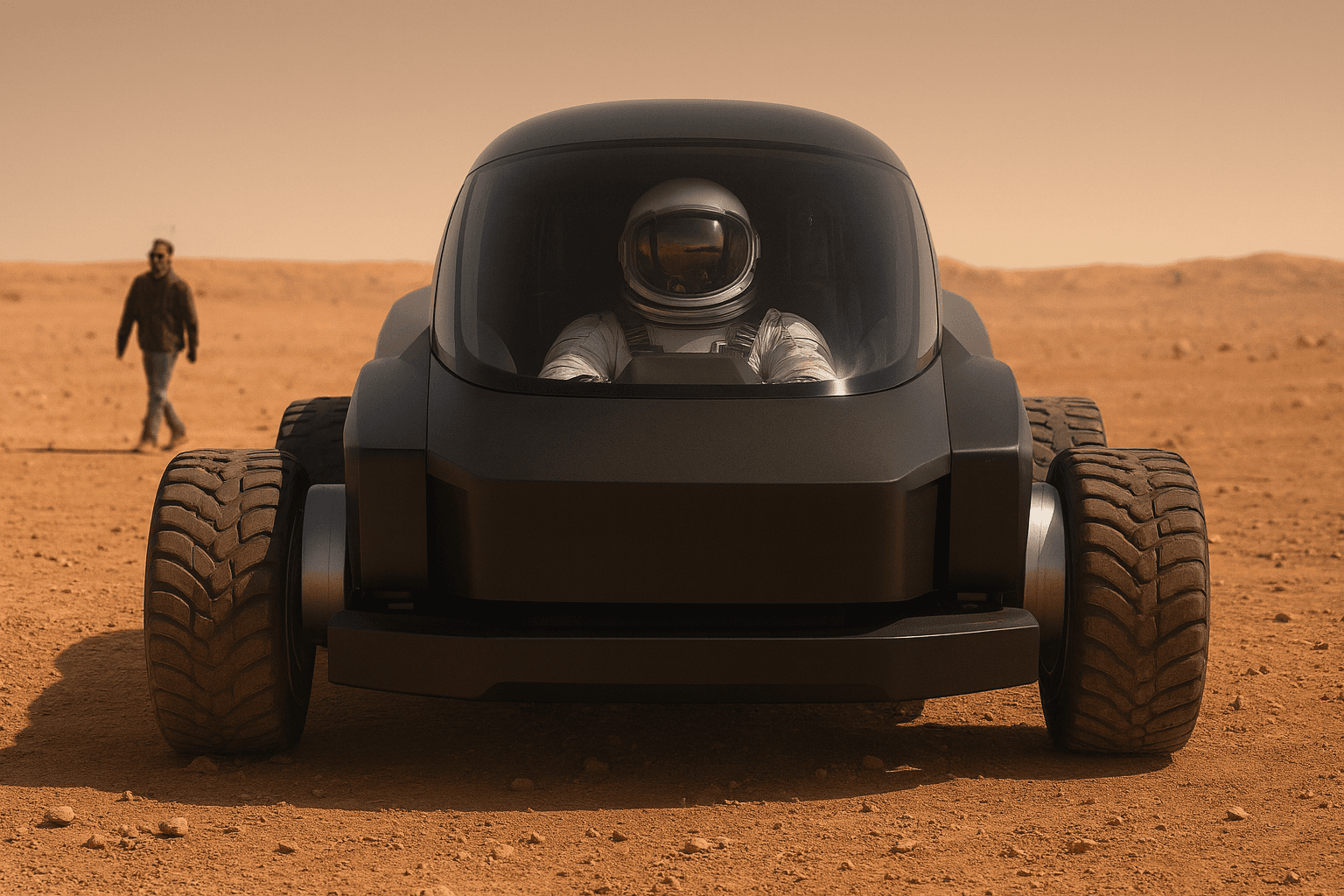 Pressurized cabin 2-seater sports vehicle for Mars driving
This is a concept for a two-seater high-performance sports vehicle capable of driving in the Martian surface environment. The goal is to maintain the design language of mid-engine sports cars for Earth (low overall height, wide track, and long rear cabin volume) while incorporating an electric drivetrain and airtight structure that can actually function in the low-pressure, low-temperature, and fine-dust environment of Mars. The seating configuration has been confirmed as a two-seater airtight pressurized cabin. Therefore, the canopy or door openings, airtight seals, airlocks, or docking interfaces become key constraints on the shape. The primary users are personnel stationed at the Mars base and operators for demonstration and tourism purposes, and the operating environment consists of flat regolith and gentle slopes near the base. Since the body panels have been confirmed to be manufactured using carbon fiber reinforced polymer (CFRP), the minimum radius of curvature, lamination thickness, split lines, and demolding direction govern the shape rules of the panels.
Paul